This workshop describes a gap in scholarship on ancient Mediterranean literature, and demonstrates a way to address it via a digital humanities project that is at once a research tool and an interactive work of public scholarship. The gap results from the fact, well-known among scholars but still startling to much of the public, that ancient Israel had no Bible as we know it. This is the case for the Persian and Hellenistic period, when, as we know largely from the evidence of the Dead Sea Scrolls, the textual form of many biblical books and the biblical canon as a unit was not yet fixed. But it is also true in a different way for an earlier period in the history of the Pentateuch, before the texts were edited into their current form. With this consensus as a starting point, we present the opportunity to visualize the most widely-agreed on possible sources and layers of the Pentateuch separately, offering a glimpse of texts closer to what people in ancient Israel may have actually had, and letting readers experiment with how they may have been combined.
The Primary Text Lab series, directed by Julia Lindenlaub, brings together a panel of scholars to examine closely a single text from different perspectives, in an open conversation on any aspect of its interpretation.
Come join us for the spring return of the Primary Text Lab series! This time we are delighted to feature a Text Lab alum alongside a new group of scholars to discuss this fascinating text. Many thanks to Elizabeth Schrader for bringing together this great lineup in mutual love of Pistis Sophia! We hope to see you there and for more events in the series throughout the year.
Panellists
Elizabeth SchraderJulia HintlianHugo LundhaugCharles Stang
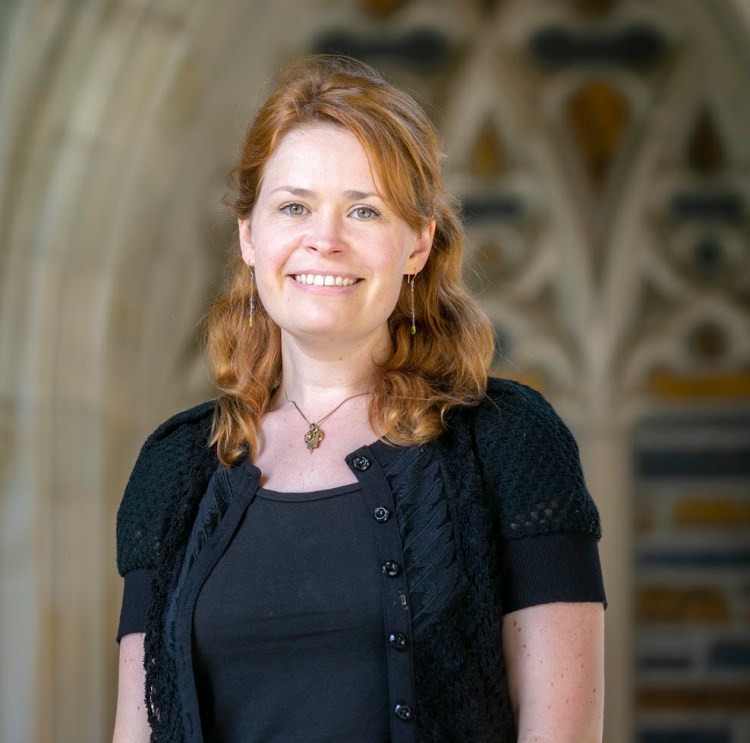
Elizabeth Schrader is a doctoral candidate in early Christianity at Duke University’s graduate program in religion. Her research interests include textual criticism, the New Testament gospels, the Nag Hammadi corpus, Mary Magdalene, and feminist theology. She holds an MA and an STM from the General Theological Seminary of the Episcopal Church. Her article “Was Martha of Bethany Added to the Fourth Gospel in the Second Century?” was published in the Harvard Theological Review. Her work has been featured by both the Daily Beast and Religion News Services.
Julia Hintlian studies late ancient Christian traditions present along the religiously-diverse Silk Road. She has particular interest in Eastern Christian approaches to theological anthropology and cosmology. Her current project explores the legacy and reception of Nemesius of Emesa’s 4th-century monograph On the Nature of Man in Greek, Syriac, Armenian, and Arabic texts and contexts.
Hugo Lundhaug specializes in Coptic manuscripts and literature, with a special focus on apocryphal and monastic texts. His publications include Images of Rebirth: Cognitive Poetics and Transformational Soteriology in the Gospel of Philip and the Exegesis on the Soul (Brill, 2010), and (with Lance Jenott), The Monastic Origins of the Nag Hammadi Codices (Mohr Siebeck, 2015). He is currently leading the ERC-funded research project Storyworlds in Transition: Coptic Apocrypha in Changing Contexts in the Byzantine and Early Islamic Periods (APOCRYPHA).
Charles Stang’sresearch and teaching focus on the history of Christianity in the context of the ancient Mediterranean world, especially Eastern varieties of Christianity. More specifically, his interests include: the development of asceticism, monasticism, and mysticism in Christianity; ancient philosophy, especially Neoplatonism; the Syriac Christian tradition, especially the spread of the East Syrian tradition along the Silk Road; and other philosophical and religious movements of the ancient Mediterranean, including Gnosticism, Hermeticism, and Manichaeism.
Have a primary text you’d like to discuss? Propose a Primary Text Lab! Proposals from scholars at all stages, including graduate students, are warmly welcome. See the Event Toolkit to get started and feel free to contact Julia Lindenlaub directly with your idea!
This event has unfortunately been postponed due to unforseen circumstances. We anticipate rescheduling in the summer and apologise for any inconvenience!
Join us for a roundtable discussion on balancing teaching, scholarship, service, and life with a heavy course load. We will discuss pedagogical, organizational, and assessment tips, as well as how to navigate some of the unspoken challenges that come with certain teaching contexts.
The Primary Text Lab series, directed by Julia Lindenlaub, brings together a panel of scholars to examine closely a single text from different perspectives, in an open conversation on any aspect of its interpretation.
Come join us for the return of the Primary Text Lab with a Christmas special! We are delighted to feature a great group of scholars to discuss this fascinating text. Many thanks to Elizabeth Corsar for bringing together this panel in mutual love of the Protevangelium of James! We hope to see you there and in the new year for more events in the series.
Panellists
Elizabeth Corsar
Brandon Hawk
Eric Vanden Eykel
Lily Vuong
Elizabeth Corsar’s primary research interests lie in New Testament studies, particularly the Gospel of John. Recently, she has become interested in the relationship between texts on both sides of the canonical divide, especially the concept of the borrowing and reworking of canonical material by authors of early Christian texts. Most recently, she has been interested in the borrowing and reworking of the Gospel of John in the Protevangelium of James.
Brandon Hawk specializes in medieval literature, with particular interests in the history of the transmission of the Bible and apocrypha. His publications include Preaching Apocrypha in Anglo-Saxon England (University of Toronto Press, 2018), The Gospel of Pseudo-Matthew and the Nativity of Mary (Cascade Books, 2019), and Apocrypha for Beginners: A Guide to Understanding and Exploring Scriptures Beyond the Bible (Rockridge Press, 2021).
Eric Vanden Eykel researches early Christian Apocrypha, with a particular focus on texts and traditions about the infancies and childhoods of Jesus and Mary. He is the author of a monograph entitled “But Their Faces Were All Looking Up”: Author and Reader in the Protevangelium of James (Bloomsbury T&T Clark, 2016), and is currently working on a book on the reception history of Matthew’s Magi.
Lily Vuong’s research interests include women and gender in early Christianity, early Christian Apocrypha, Jewish-Christian relations, and religious competition in antiquity. She has authored two books and several articles on the Protevangelium of James as well as edited two volumes on religious competition in late antiquity. She is presently working on gendering and regendering in the Acts of Thecla and Acts of Xanthippe.
Have a primary text you’d like to discuss? Propose a Primary Text Lab! Proposals from scholars at all stages, including graduate students, are warmly welcome. See the Event Toolkit to get started and feel free to contact Julia Lindenlaub directly with your idea!
From the BRANE Collective in partnership with the North American Society for the Study of Christian Apocryphal Literature and the Second Temple Early Career Academy
Organised by Julia Lindenlaub and Chance Bonar
Featuring Sophus Helle, Robyn Faith Walsh, Chance McMahon, and Marieke Dhont, with David Brakke
This colloquium brings together scholars working on early Judaism, early Christianity, and Classics to discuss authorship and attribution beyond the typical boundaries of our fields. Monthly events from September through December feature panel discussions of prominent work in this area, alongside new research presentations. Come join us to hear interdisciplinary dialogue on authorial fictions and attributions in the ancient Mediterranean, featuring top scholars in ancient history, as well as rising stars among early career researchers!
We hope you will join us for this finale event to our series!
Programme
Sophus Helle, ‘Narratives of Authorship: Studying Authorial Attributions in Ancient Iraq’
Robyn Faith Walsh, ‘The Epistle to the Laodiceans and the Art of Tradition’
Chance McMahon, ‘Philological Power and Narratives of Authorization: Mosaic Discourse and Imperial Power in Ezra, the Letter of Aristeas, and Rabbinic Narratives’
Marieke Dhont, ‘Greek-Speaking Judaism in the Late Second Temple Period’
With responses from David Brakke
Participants
Sophus Helle
Robyn Faith Walsh
Chance McMahon
Marieke Dhont
David Brakke
Sophus Helle is a writer, translator, and cultural historian focusing on premodern literature, especially the Babylonian epics of ancient Iraq. He has recently published a new translation of the Babylonian epic Gilgamesh, and has just submitted a translation of the complete poems of Enheduana, the first known author. His latest project is to study some of the theoretical questions thrown up by the recent emergence of the field of world philology.
Robyn Faith Walsh‘s primary area of study is early Christianity and the New Testament. She also works in theory and method and archaeology. She is currently working on a book manuscript on the gospels and economics in the imperial period.
Chance McMahon‘s research focuses on how ancient Israelite, Jewish, and Christian literature adapt or represent imperial political ideology both to deconstruct such ideologies while presenting an alternative social order that often mirrors imperial political ideology.
Marieke Dhont‘s main areas of interest are Hellenistic Judaism, the Hebrew Bible in the Hellenistic period, and Jewish-Greek literature. She engages sociolinguistics and contemporary theories of culture, literature, and translation. Her first monograph, entitled Style and Context of Old Greek Job, appeared with Brill in 2018.
David Brakke studies the history and literature of ancient Christianity from its origins through the fifth century. He has special interests in early monasticism, “Gnosticism,” and the functions of scripture in early Christian communities. His recent projects include a commentary on the Gospel of Judas for the Anchor Yale Bible and a new translation of the Festal Letters of Athanasius of Alexandria.
This 45 minute workshop is geared for undergraduate students who want to improve their writing skills and produce stronger, clearer critical essays. The workshop will go over some basic tips and tricks that demystify the process: how to structure an essay, ways to build a critical argument, how to use sources effectively, knowing how to write for a specific audience or reader, and easy ways to keep your writing tight and focused. We will also go over how even just rethinking what it means to write a university-level essay can dramatically improve your writing and consistently lead to success in writing assignments.
The workshop will take place via zoom on NOVEMBER 23rd, 5pm EST, and will be conducted by BRANE Collective member Mark Leuchter. The signup link for the zoom session is here:
From the BRANE Collective in partnership with the North American Society for the Study of Christian Apocryphal Literature and the Second Temple Early Career Academy
Organised by Julia Lindenlaub and Chance Bonar
Featuring Ben Wright, Eva Mroczek, Jamey Walters, Tim Whitmarsh, Tom Geue, Candida Moss, and Sarah Rollens
Tuesday, November 9, 2021
Panel 1: 12:00-1:30pm EST / 6:00-7:30pm CET Panel 2: 2:00-3:30pm EST / 8:00-9:30pm CET
This colloquium brings together scholars working on early Judaism, early Christianity, and Classics to discuss authorship and attribution beyond the typical boundaries of our fields. Monthly events through December will feature panel discussions of prominent work in this area, alongside new research presentations. Come join us to hear interdisciplinary dialogue on authorial fictions and attributions in the ancient Mediterranean, featuring top scholars in ancient history, as well as rising stars among early career researchers!
Stay tuned for further registration details for our final event on December 9!
Panel 1: Panellists Ben Wright, Eva Mroczek, Jamey Walters, and Tim Whitmarsh will discuss the essay: Benjamin G. Wright III and Eva Mroczek, “Ben Sira’s Pseudo-Pseudepigraphy: Idealizations from Antiquity to the Early Middle Ages,” in Sirach and Its Contexts: The Pursuit of Wisdom and Human Flourishing, ed. Samuel Adams, Greg Schmidt Goering, and Matthew J. Goff, JSJSupp 196 (Leiden: Brill, 2021), 213-239.
Panel 2: Panellists Tom Geue, Candida Moss, and Sarah Rollens will discuss the book: Tom Geue, Author Unknown: The Power of Anonymity in Ancient Rome (Cambridge, MA: Harvard, 2019).
Panellists for Event 1
Ben Wright
Eva Mroczek
Jamey Walters
Tim Whitmarsh
Benjamin Wright has broad interests in the study of Early Judaism, focusing primarily on Wisdom literature, particularly the Wisdom of Ben Sira, and the Septuagint and ancient translations. His most recent book is a commentary on the Letter of Aristeas (de Gruyter, 2015). Lately he has written on notions of time in ancient Judaism, the use of the Apocrypha among Jews, and the application of globalization theory to ancient Judaism. He is currently working on a commentary on Ben Sira.
Eva Mroczek writes on early Jewish literary culture. She is the author of The Literary Imagination in Jewish Antiquity and is finishing a book on ancient and modern manuscript discovery narratives.
Jamey Walters is a scholar of late ancient Christianity in the Eastern Mediterranean world. In particular, he enjoys thinking about the translation and transmission of texts throughout the Christian East, the manuscripts that carried those texts, and the scribes who copied them.
Tim Whitmarsh is the author of numerous books and articles on aspects of ancient Greek literature, culture, thought, and religion, including Battling the Gods: Atheism in the Ancient World (2015) and Dirty Love: The Genealogy of the Ancient Greek Novel (2018). He is general editor of the Oxford Classical Dictionary (5th edition). He is currently editing a collected volume of translations of the Greek epic poets of the Roman Empire.
Panellists for Event 2
Tom Geue
Candida Moss
Sarah Rollens
Tom Geue teaches Latin literature at the University of St Andrews. He has written about Roman satire, anonymous Roman literature, and the repression and eruption of slavery in Virgil’s Georgics. He’s now at work on a book between intellectual history and classical scholarship, called Major Corrections: the Materialist Philology of Sebastiano Timpanaro, which seeks to understand what it means for technical philology and militant Marxism to work together towards a future of full human flourishing.
Candida Moss is a scholar of early Christianity who has published on martyrdom, disability, resurrected bodies, and antiquities trafficking. She is invested in communicating academic insights to a broader public and is currently working on a book on enslaved literate works and the New Testament.
Sarah Rollens’ work focuses on the social context and history of earliest Christianity. Her first book Framing Social Criticism in the Jesus Movement: The Ideological Project of the Sayings Gospel Q came out in 2014. She has published articles on the social history of Christianity, the synoptic problem, voluntary associations and Paul’s groups, theoretical issues in the study of Christian origins, among many other topics.
From the BRANE Collective in partnership with the North American Society for the Study of Christian Apocryphal Literature and the Second Temple Early Career Academy
Organised by Julia Lindenlaub and Chance Bonar
Featuring Jeremiah Coogan, Alin Suciu, Olivia Stewart Lester, and Natalie Dohrmann, with Tobias Nicklas
This colloquium brings together scholars working on early Judaism, early Christianity, and Classics to discuss authorship and attribution beyond the typical boundaries of our fields. Monthly events through December will feature panel discussions of prominent work in this area, alongside new research presentations. Come join us to hear interdisciplinary dialogue on authorial fictions and attributions in the ancient Mediterranean, featuring top scholars in ancient history, as well as rising stars among early career researchers!
Stay tuned for further registration details for our upcoming events on November 9 and December 9!
Programme
Jeremiah Coogan, “Early Christian Negotiations of Gospel Authorship”
Alin Suciu, “Authorship and Fiction in the Coptic Apostolic Memoirs”
Olivia Stewart Lester, “Can a Fictional Prophet Be an Author? Attribution and the Production of the Sibylline Oracles”
Natalie Dohrmann, “Rabbinic Authorship, Authority, and Canon Making”
Tobias Nicklas, Respondent
Participants
Jeremiah Coogan
Alin Suciu
Olivia Stewart Lester
Natalie Dohrmann
Tobias Nicklas
Jeremiah Coogan is a scholar of the New Testament and early Christianity whose research focuses on Gospel reading, material texts, and late antiquity. His forthcoming monograph, Eusebius the Evangelist, analyses Eusebius of Caesarea’s fourth-century reconfiguration of the Gospels as a window into broader questions of technology and textuality in early Christianity and the late ancient Mediterranean. His current book project investigates how early Christians deployed literary and bibliographic categories to understand similarities and differences between Gospel texts.
Alin Suciu is specialised in the history and literatures of Eastern Christian Churches, with a special emphasis on the Egyptian Coptic Church. He is particularly interested in the transmission of apocryphal and patristic literature from early Christian centuries to medieval times. He is the author of the Berlin-Strasbourg Apocryphon: A Coptic Apostolic Memoir (Tübingen, 2017).
Olivia Stewart Lester’s research focuses on prophecy in Hellenistic Judaism, early Christianity, and the larger ancient Mediterranean. Her first book is entitled Prophetic Rivalry, Gender, and Economics: A Study in Revelation and Sibylline Oracles 4–5 (Mohr Siebeck, 2018). The book adds to a growing body of scholarship challenging narratives about prophecy’s decline in the early Roman imperial period and examines constructions of true and false prophecy at the intersections of interpretation, gender, and economics. She is currently working on a monograph on the Jewish-Christian Sibylline Oracles.
Natalie Dohrmann is a scholar of early rabbinic Judaism, with a special interest in the place of rabbinic law in the imperial culture of the Roman Near East. Her most recent piece is “Ad similitudinem arbitrorum: On the Perils of Commensurability and Comparison in Roman and Rabbinic Law,” in Legal Engagement: The Reception of Roman Tribunals and Law by Jews and Other Provincials of the Roman Empire, edited by K. Berthelot, N. B. Dohrmann, and C. Nemo-Pekelman (École française de Rome, 2021).
Tobias Nicklas, born 1967, has published a wealth of research on early Christianity, including apocryphal literature, New Testament, reception history, and canonisation. As the director of the Beyond Canon research centre, his work continues to explore these topics.
From the BRANE Collective in partnership with the North American Society for the Study of Christian Apocryphal Literature and the Second Temple Early Career Academy
Organised by Julia Lindenlaub and Chance Bonar
Featuring Karen King, Joseph Howley, Liv Ingeborg Lied, Roberta Mazza, Hindy Najman, Irene Peirano Garrison, Hugo Méndez, and Patricia Rosenmeyer
Friday, September 24, 2021
Panel 1: 9:30-11:00am EST / 3:30-5:00pm CET Panel 2: 2:30-4:00pm EST / 8:30-10:00pm CET
This colloquium brings together scholars working on early Judaism, early Christianity, and Classics to discuss authorship and attribution beyond the typical boundaries of our fields. Monthly events through December will feature panel discussions of prominent work in this area, alongside new research presentations. Come join us to hear interdisciplinary dialogue on authorial fictions and attributions in the ancient Mediterranean, featuring top scholars in ancient history, as well as rising stars among early career researchers!
Stay tuned for further registration details for our upcoming events on October 5, November 9, and December 9!
Panel 1: Panellists Karen King, Joseph Howley, Liv Ingeborg Lied, and Roberta Mazza will discuss the essay: Karen L. King, “‘What is an Author?’: Ancient Author-Function in the Apocryphon of John and the Apocalypse of John,” in Scribal Practices and Social Structures Among Jesus Adherents: Essays in Honour of John S. Kloppenborg, ed. William E. Arnal et al., BETL 285 (Leuven: Peeters, 2016), 15-42.
Panel 2: Panellists Hindy Najman, Irene Peirano Garrison, Hugo Méndez, and Patricia Rosenmeyer will discuss the essay: Hindy Najman and Irene Peirano Garrison, “Pseudepigraphy as an Interpretive Construct,” in The Old Testament Pseudepigrapha: Fifty Years of the Pseudepigrapha Section at the SBL, ed. Matthias Henze and Liv Ingeborg Lied, SBLEJL 50 (Atlanta: SBL, 2019), 331-355.
Panellists for Event 1
Karen King
Joseph Howley
Liv Ingeborg Lied
Roberta Mazza
Karen L. Kingwas trained in comparative religions and historical studies. She is the author of books and articles on the diversity of ancient Christianity, women and gender studies, and religion and violence. Her particular passion is studying recently discovered literature from Egypt, including The Gospel of Mary, The Apocalypse of James, The Gospel of Philip, and The Secret Revelation of John.
Joseph Howley teaches Latin, the history of the book, and the humanities and literature more broadly. He has published on Roman intellectual and reading cultures, including Roman study abroad and juristic writing, as well as the history of the book and reading. His first book, Aulus Gellius and Roman Reading Culture: Text, Presence and Imperial Knowledge in the Noctes Atticae, was published in 2018 by Cambridge University Press. His current project concerns enslaved labor in the history of the Roman book.
Liv Ingeborg Lied is a scholar of early Jewish texts and their manuscript transmission. She is interested in the methods, ethics and epistemologies of textual scholarship and the academic imagination of ancient literature.
Roberta Mazza is an expert of Graeco-Roman material culture and papyrologist. Her primary interests include the history of Egypt in the Graeco-Roman period, late antiquity, and the rise of Christianity. Her most recent research looks at the materiality of texts and the ethics involved in collecting, handling and publishing ancient papyrus manuscripts.
Panellists for Event 2
Hindy Najman
Irene Peirano Garrison
Hugo Méndez
Patricia Rosenmeyer
Hindy Najman’s research interests encompass Composition and Author Function; Construction and Imitation of Biblical Figures; Pseudepigraphy and Attribution; Revelation; Idealized Sage; Perfectionism; Philological Practices; Diaspora and Exile; Authority and Authenticity; Allegorical Interpretation and Midrash; Destruction and Trauma; Collection and Canon; Generic categories; Performance and Poetics; the History of Biblical Interpretation; and Scholarly Practices of Reading biblical traditions. She focuses on Hebrew Bible; Dead Sea Scrolls; Hellenistic Jewish Literature, especially Philo of Alexandria and early Rabbinic literature and ancient Jewish liturgy.
Irene Peirano Garrison works on Roman poetry and its relation to rhetoric and literary criticism, both ancient and modern. She is especially interested in ancient strategies of literary reception, in notions of authorship in antiquity and in the history of scholarship.
Hugo Méndez is a New Testament scholar, whose work foregrounds the role invention and pseudepigraphy have played in early Christian attempts to lay claim to the biblical and establish a discursive authority over it. His first book, The Cult of St. Stephen in Jerusalem: Inventing a Patron Martyr, is forthcoming with Oxford University Press. He is currently writing a second monograph tentatively entitled Gospel Truth: The Books of John as a Literary Tradition of Pseudepigraphy.
Patricia A. Rosenmeyer‘spublications include books on non-canonical authors and “marginal” topics: The Poetics of Imitation (CUP 1992); Ancient Epistolary Fictions (CUP 2001); Ancient Greek Literary Letters (Routledge 2006); and The Language of Ruins (OUP 2018). She is currently working on a commentary on Sappho for undergrads, and a study of Jewish receptions of classical literature.
A link to the text to be discussed will be included in your registration confirmation email.
The Primary Text Lab series, directed by Julia Lindenlaub, brings together a panel of scholars to examine closely a single text from different perspectives, in an open conversation on any aspect of its interpretation.
The Ascension of Isaiah is a text from the Roman Mediterranean that has left its fingerprints in a wide range of contexts and that enjoys a rich ongoing life in the Ethiopic Christian tradition. The text narrates the prophet Isaiah’s execution by Manasseh and recounts Isaiah’s vision of future events. Although it is often described as an apocalypse, the Ascension of Isaiah defies simple categorisation. As a result, it invites capacious conversation about the categories that modern scholars use to understand ancient texts —such as dependence and intertextuality or ‘Judaism’ and ‘Christianity’ — and about how we study texts with expansive histories across historical, linguistic, and religious contexts.
Come join us on 23 June to think with an international panel of scholars who engage the Ascension of Isaiah from a range of scholarly perspectives and at various points in its long history of reception. Participants are invited to read the brief text in preparation for the panel or simply to show up and learn from the conversation.
Jeremiah Coogan, curator of this text lab, is a scholar of the New Testament and early Christianity whose research focuses on Gospel reading, material texts, and late antiquity. His forthcoming monograph, Eusebius the Evangelist, analyses Eusebius of Caesarea’s fourth-century reconfiguration of the Gospels as a window into broader questions of technology and textuality in early Christianity and the late ancient Mediterranean. His current project uses the complex reception of Matthew’s Gospel to engage ongoing debates about continuity and change in Second Temple, rabbinic, and early Christian texts.
Discussants
Warren Campbell
David Frankfurter
Meghan Henning
Emily Gathergood
Warren Campbell works along the borderline of early Jewish and early Christian studies, focusing on questions of exchange, emergence, textual transmission, and identity. Warren’s current project concerns the depiction of a Jewish Paul in the literary and material appropriation of To the Hebrews as a Pauline letter in second- and third-century Egypt.
David Frankfurter works on apocalyptic literature, as well as popular religion, demonology, magic, and material devotion in Roman and late antique Egypt, with interests also in prophetic movements in early Roman Asia Minor.
Emily Gathergood researches women in early Jewish and Christian texts and artefacts, with a particular interest in the construction of women’s bodies in relation to salvation. Her current project, The Midwifery of God, focuses on the early reception of Eve’s childbearing ‘curse’ (Genesis 3:16) in a cluster of texts which envisage its divine reversal – including the Ascension of Isaiah.
Meghan Henning works on the New Testament and Early Christianity, hell, apocalyptic literature, apocryphal literature, ancient rhetoric, disability studies, gender, reception history, and ancient pedagogy. Meghan’s first book on the pedagogical function of Hell in antiquity is entitled Educating Early Christians through the Rhetoric of Hell. Her forthcoming book, Hell Hath No Fury (September 2021), is about the conceptualisation of gender, disability, and the body in the early Christian apocalypses.
Have a primary text you’d like to discuss? Propose a Primary Text Lab! Proposals from scholars at all stages, including graduate students, are warmly welcome. See the Event Toolkit to get started!















 Bible and Religions of the Ancient Near East Collective